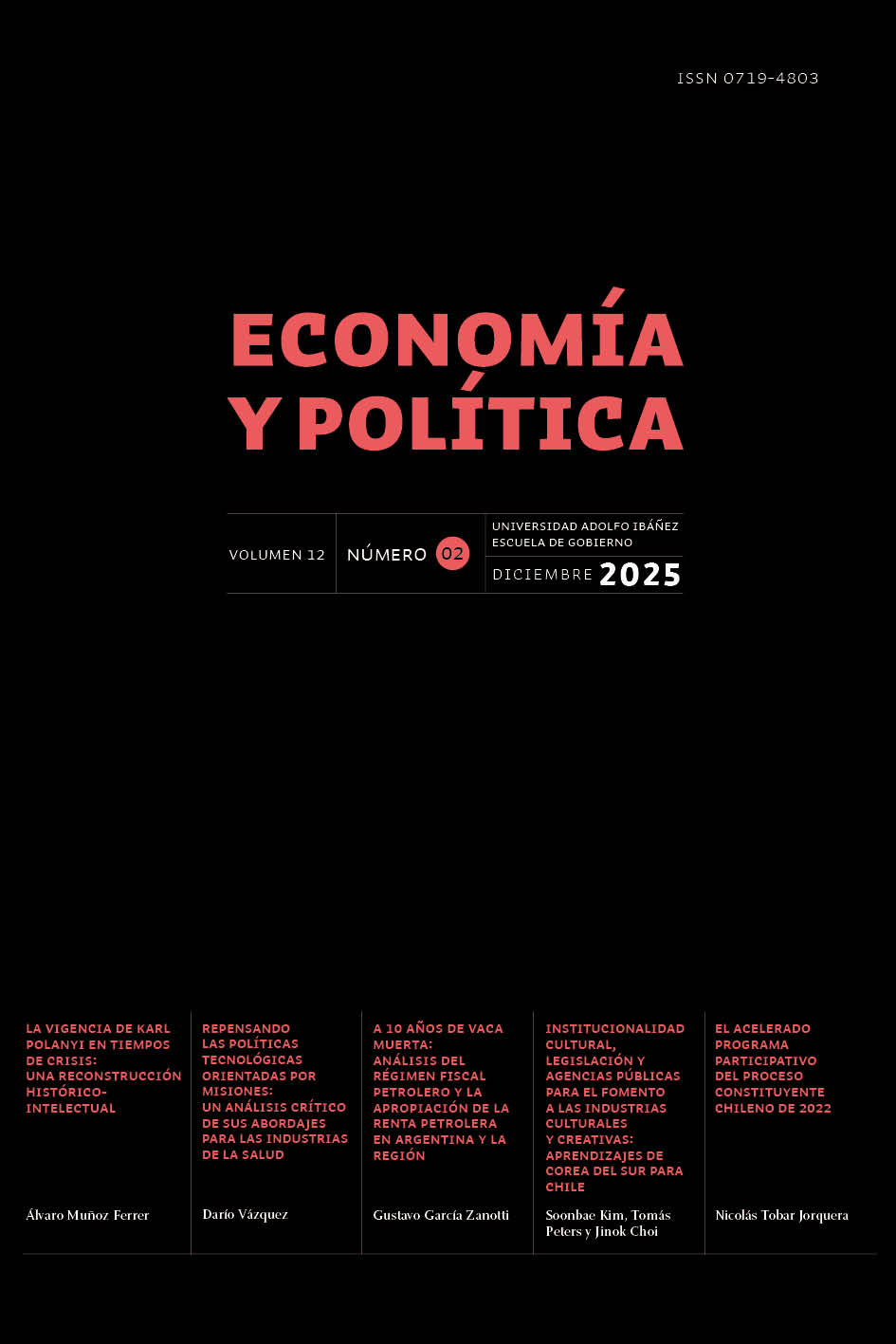
Rethinking Mission-Oriented Technology Policies: a Critical Analysis of their Approaches to Health Industries
DOI:
https://doi.org/10.15691/07194714.2025.005Keywords:
Mission-oriented policies, Innovation, Health industries, Health Economic-Industrial ComplexAbstract
Recently, Mission-Oriented Policies (MOPs) have regained public prominence, having peaked during the post-World War II era. Today, they are being promoted as a response to the search for technological solutions to major social challenges, many of which are related to the health sector. Despite their place in the debate on industrial policies, few approaches to MOPs have engaged with the field of international health. This work aims to contribute to filling that gap by providing a critical analysis of MOPs, considering two aspects that address the link between these policies and the socioeconomic determinants of health: their relationship with capitalism and with the core-periphery divide. From the connection between missions and health, two broad versions of MOPs emerge, which we term transformative and welfare-oriented, respectively. It is argued that combining transformative MOPs with more systemic and holistic approaches (e.g., the Health Economic-Industrial Complex framework) could serve as a tool to promote relevant structural changes in the health dynamics of peripheral countries.
References
Abeles, M., Cimoli, M. y Lavarello, P. J. (2018). Manufactura y cambio estructural: aportes para pensar la política industrial en la Argentina. CEPAL.
Adler, E. (1987). The Power of Ideology: the Quest for Technological Autonomy in Argentina and Brazil (Vol. 16). University of California Press.
Almeida, C. (2013). Saúde, política externa e cooperação sul-sul em saúde: elementos para a reflexão sobre o caso do Brasil, en A saúde no Brasil em 2030 – prospecção estratégica do sistema de saúde brasileiro: desenvolvimento, Estado e políticas de saúde. Fundação Oswaldo Cruz
Almeida-Filho, N. D. (2020). Etnoepidemiología y salud mental: perspectivas desde América Latina. Salud Colectiva 16, e2786.
Arocena, R. y Sutz, J. (2006). Brain Drain and Innovation Systems in the South. International Journal on Multicultural Societies 8(1), 43-60.
Arocena, R. y Sutz, J. (2012). Research and Innovation Policies for Social Inclusion: An Opportunity for Developing Countries. Innovation and Development 2(1), 147-158.
Bárcena Ibarra, A., Prado, A. y Abeles, M. (2015). Estructura productiva y política macroeconómica: enfoques heterodoxos desde América Latina. CEPAL.
Birn, A.-E. (2009). The Stages of International (Global) Health: Histories of Success or Successes of History? Global Public Health 4(1), 50-68.
Birn, A.-E. (2015). Filantrocapitalismo: ¿Qué representa este término para la salud del mundo?. Revista RETS 6.
Block, F. y Keller, M. R. (2011). State of Innovation. Boulder-Londres: Paradigm Publishers.
Bortz, G., Becerra, L. y Thomas, H. (2018). De la “transferencia tecnológica” al desarrollo local. Dinámicas sociotecnocognitivas en el caso del Yogurito Escolar (Argentina, 1984-2015). Apuntes 45(82), 33-69.
Boullenois, C., Black, M. y Rosen, D. H. (2025). Was Made in China 2025 Successful? Rhodium Group.
Bozeman, B. (2000). Technology Transfer and Public Policy: a Review of Research and Theory. Research Policy 29(4-5), 627-655.
Braveman, P. (2023). The Social Determinants of Health and Health Disparities. Oxford University Press.
Breilh, J. (2010). La epidemiología crítica: una nueva forma de mirar la salud en el espacio urbano. Salud Colectiva 6, 83-101.
Breilh J. (2013). La determinación social de la salud como herramienta de transformación hacia una nueva salud pública (salud colectiva). Rev. Fac. Nac. Salud Pública 31: S13-S27.
Brown, T. M., Cueto, M. y Fee, E. (2006). The World Health Organization and the Transition from “International” to “Global” Public Health. American Journal of Public Health 96(1), 62-72.
Cardona, A. (2013). Salud pública, Estado y sociedad. Itinerario de una reflexión crítica. Medellín: Litocromía.
Castellani, A. (2008). Ámbitos privilegiados de acumulación. Notas para el análisis del caso argentino (1976-1989). Apuntes de Investigación del CECYP (14), 139-157.
Chang, H. J. (2010). How to 'Do' a Developmental State: Political, Organisational and Human Resource Requirements for the Developmental State (82-96), en O. Edigheji (ed.), Constructing a Democratic Developmental State in South Africa: Potentials and Challenges. HSRC Press.
Chesnais, F. (1990). Compétitivité internationale et dépenses militaires. París: Économica.
Chesnais, F. (1994). La mondialisation du capital. París: Syros.
Chesnais, F. (1997). Multinationales et technologie: une domination renforcée. Quaderni 31. Les technologies à l'épreuve de la mondialisation, 97-110.
Chiang, J. T. (1991a). From “Mission-Oriented” to “Diffusion-Oriented” Paradigm: the New Trend of U.S. Industrial Technology Policy. Technovation 11(6), 339-356.
Chiang, J. T. (1991b). Technological Spin-Off: Its Mechanisms and National Contexts. Technological Forecasting and Social Change 41(4), 365-390.
Codner, D., Becerra, P. y Díaz, A. (2012). Blind Technology Transfer or Technological Knowledge Leakage: a Case Study from the South. Journal of Technology Management & Innovation 7(2), 184-195.
Coenen, L., Hansen, T. y Rekers, J. V. (2015). Innovation Policy for Grand Challenges. An Economic Geography Perspective. Geogr. Compass 9, 483-496.
Dos Santos, T. (2014 [1970]). The Structure of Dependence (59-64), en Latin America's International Relations and Their Domestic Consequences. Routledge.
Ergas, H. (1987). Does Technology Policy Matter? Technology and Global Industry: Companies and Nations in the World Economy, 191-245.
Epstein, G. A. (ed.). (2005). Financialization and the World Economy. Cheltenham: Edward Elgar.
European Commission (2011). Green Paper-From Challenges to Opportunities: Towards a Common Strategic Framework for EU Research and Innovation Funding. Bruselas: European Commission.
Fajnzylber, F. (1983). La industrialización trunca de América Latina. Nueva Imagen.
Ferrer, A. (2014 [1974]). Tecnología y política económica en América Latina. Quilmes: UNQ Editora.
Foray, D., Mowery, D. C. y Nelson, R. R. (2012). Public R&D and Social Challenges: What Lessons from Mission R&D programs? Research Policy, Elsevier 41(10), 1697-1702.
Franco-Giraldo, A. (2013). Determinación global y salud: el marco amplio de los determinantes de la salud. Rev. Fac. Nac. Salud Pública 31(supl 1), S73-S86.
Freeman, C. (2004 [1982]). Technological Infrastructure and International Competitiveness. Industrial and Corporate Change 13(3), 541-569.
Gadelha, C. A. G. (2003). O complexo industrial da saúde e a necessidade de um enfoque dinâmico na economia da saúde. Ciência & Saúde Coletiva 8, 521-535.
Gadelha, C. A. G., Costa, L. S., Maldonado, J., Santo, M. y Metten, A. (2013). O complexo produtivo da saúde e sua articulação com o desenvolvimento socioeconômico nacional. Revista do Serviço Público 64(2), 177-199.
Gereffi, G. (2020). What Does the COVID-19 Pandemic Teach Us about Global Value Chains? The Case of Medical Supplies. Journal of International Business Policy 3, 287-301.
Guédez, Y. (2009). Misión Barrio Adentro I: cinco años del modelo de atención primaria en salud de la República Bolivariana de Venezuela. Rev. Esc. Salud Pública, 49-59.
Harvey, D. (1990 [1982]). Los límites del capitalismo y la teoría marxista. Economía Contemporánea.
Herder, M., Graham, J. E. y Gold, R. (2020). From Discovery to Delivery: Public Sector Development of the r VSV-ZEBOV Ebola Vaccine. Journal of Law and the Biosciences 7(1), lsz019.
Karo, E. y Lember, V. (2016). Emergence of Societal Challenges-Based Innovation Policies in Market-Based Innovation Systems: Lessons from Estonia. International Journal of Foresight and Innovation Policy 11(1-3), 126-147.
Keller, M. R. y Block, F. (2015). Do As I Say or As I Do? US Innovation and Industrial Policy since the 1980s (219-246). En Development and Modern Industrial Policy in Practice: Issues and Country Experiences.
Koplan, J. P., Bond, T. C., Merson, M. H. et al. (2009). Towards a Common Definition of Global Health. The Lancet 373(9679), 1993-1995.
Kuhlmann, S. y Rip, A. (2014). The Challenge of Addressing Grand Challenges. EU Commission.
Larrue, P. (2021). The Design and Implementation of Mission-Oriented Innovation Policies. OECD Science, Technology and Industry Policy Papers.
Lavarello, P., Minervini, M., Robert, V. y Vázquez, D. (2020). Las políticas orientadas por misiones: el debate en los países centrales y su aplicación en países en desarrollo. En D. Suarez, A. Erbes y F. Barletta, Teoría de la innovación. Complutense y UNGS.
Lavoie, M. (2022). A Public Health Mission in Canada in Response to the Coronavirus Disease 2019 (COVID-19) Pandemic. Global Health Journal 6(4), 231-236.
Leadbeater, C. y Winhall, J. (2021). System Innovation on Purpose. The Rockwool Foundation. Interventions.
Lundvall, B. Å. (2024). Transformative Innovation Policy-Lessons from the Innovation System Literature. Innovation and Development 14(2), 297-314.
Mazzucato, M. (2015). Building the Entrepreneurial State: A New Framework for Envisioning and Evaluating a Mission-Oriented Public Sector (Working Paper No. 824). Nueva York.
Mazzucato, M. (2017). Mission-Oriented Innovation Policy. Challenges and Opportunities. Action and Research Centre, UCL Institute for Innovation and Public Purpose.
Mazzucato, M. (2018). Mission-Oriented Research & Innovation in the European Union. European Commission 36.
Mazzucato, M. (2021). Mission Economy: A Moonshot Guide to Changing Capitalism. Penguin UK.
Mazzucato, M. (2025). Reimagining Financing for the SDGs: from Filling Gaps to Shaping Finance. UN DESA Policy Brief 170(Special).
Mazzucato, M. y Dibb, G. (2020). Innovation Policy and Industrial Strategy for Post-Covid Economic Recovery. UCL IIPP Policy Brief 10. Londres.
Mazzucato, M. y Penna, C. (2016). The Brazilian Innovation System: A Mission-Oriented Policy Proposal, en Avaliação de Programas em CT&I. Brasilia: Centro de Gestão e Estudos Estratégicos.
Mazzucato, M. y Torreele, E. (2016). Fair Vaccine Pricing Please, Not Random Acts of Charity. Disponible en: https://www.bmj.com/content/355/bmj.i6173.full
Mazzucato, M., Doyle, S., Kimber, N., Wainwright, D. y Wyld, G. (2024). Mission Critical: Statecraft for the 21st Century.
Moncaut, N. y Robert, V. (2022). Develando la importancia de la demanda y las misiones en la vinculación efectiva universidad-empresa. Casos de estudio con participación de la UNSAM en el contexto de la pandemia COVID-19. Documento N° 2/2022. Secretaría de Investigación EIDAES-UNSAM.
National Research Council (NRC). (2012). Rising to the Challenge: US Innovation Policy for the Global Economy. National Academies Press.
Rothman, K. J. (1986). Causal Inference in Epidemiology. Modern Epidemiology, 7-21.
Rovere, M. (1992). Dimensiones internacionales de la salud (262), en OPS/ OMS (ed.), Salud pública internacional, un debate norte-sur. Washington: OPS.
Ruttan, V. W. (2006). Is War Necessary for Economic Growth? Military Procurement and Technology Development. Nueva York: Oxford University Press.
Sampat, B. N. (2012). Mission-Oriented Biomedical Research at the NIH. Research Policy 41(10), 1729-1741.
Sarthou, N. y Loray, R. (2021). Estratégico, prioritario u orientado a misiones: qué aporta la literatura a la orientación de las políticas en ciencia, tecnología e innovación en Argentina, en S. Colombo (comp.), Desarrollo y políticas de ciencia, tecnología e innovación en un mundo en transformación: reflexiones sobre la Argentina contemporánea. CEIPIL, UNICEN.
Schuster, F. (2011). Acción y estructura en política y ciencias sociales. Problemas filosóficos y metodológicos. Oposición, 11 de marzo de 2011.
Sunkel, O. (1986). Las empresas transnacionales en el capitalismo actual: algunos viejos y nuevos temas de reflexión. Estudios Internacionales 19(74), 159-169.
Swedish EU Presidency (2009). The Lund Declaration: Europe Must Focus on the Grand Challenges of our Time. Swedish EU Presidency.
UCL Institute for Innovation and Public Purpose (2018). The People’s Prescription: Re-Imagining Health Innovation to Deliver Public Value. Disponible en: https://www.ucl.ac.uk/bartlett/public-purpose/sites/public-purpose/files/peoples_prescription_report_final_online.pdf
UNCTAD (2017). New Innovation Approaches to Support the Implementation of the Sustainable Development Goals. UNCTAD.
Vázquez, D. (2018). La política tecnológica orientada por misiones y sus spillovers: un análisis empírico de las misiones dirigidas a defensa y salud humana para 1995-2014. MDE-UNSAM, Argentina.
Vázquez, D. (2020). Variety Patterns in Defense and Health Technological Systems: Evidence from International Trade Data. Journal of Evolutionary Economics 30(4), 949-988.
Velásquez, G. (mayo de 2015). ¿Sobrevivirá la OMS a la epidemia de Ébola? Le Monde Diplomatique.
Wallerstein, I. M. (2005). Análisis de sistemas-mundo: una introducción. Siglo XXI.
Wanzenböck, I. y Frenken, K. (2020). The Subsidiarity Principle in Innovation Policy for Societal Challenges. Global Transitions 2, 51-59.
Wanzenböck, I., Wesseling, J. H., Frenken, K., Hekkert, M. P. y Weber, K. M. (2020). A Framework for Mission-Oriented Innovation Policy: Alternative Pathways through the Problem-Solution Space. Science and Public Policy 47(4), 474-489.
Wargas, T. y Mattos, R. (2015). Caminhos para análise das políticas de saúde. Editora Rede Unida, 1a. ed.
Weber, K. M. y Rohracher, H. (2012). Legitimizing Research, Technology and Innovation Policies for Transformative Change: Combining Insights from Innovation Systems and Multi-Level Perspective in a Comprehensive ‘Failures’ Framework. Research Policy 41(6), 1037-1047.
Whitehead, M. y Dahlgren, G. (2007). Concepts and Principles for Tackling Social Inequities in Health. Levelling Up. Part 1. Copenhague: WHO, Regional Office for Europe.
Wilkinson, R. y Marmot, M. (eds.). (2003). Social Determinants of Health: the Solid Facts. Copenhague: WHO. Regional Office for Europe, 2a. ed.
World Bank. (1997). World Development Report 1997: The State in a Changing World. Oxford University Press.
Zukerfeld, M., Liaudat, S., Britto, F., Pereira, M. y Lerena, O. (2023). La apropiación cognitiva de las invenciones del sistema de ciencia, tecnología e innovación de la Argentina, en M. S. Terlizzi y M. Zukerfeld (eds.), Políticas de promoción del conocimiento y derechos de propiedad intelectual. Experiencias propuestas y debates para la Argentina. CIECTI.