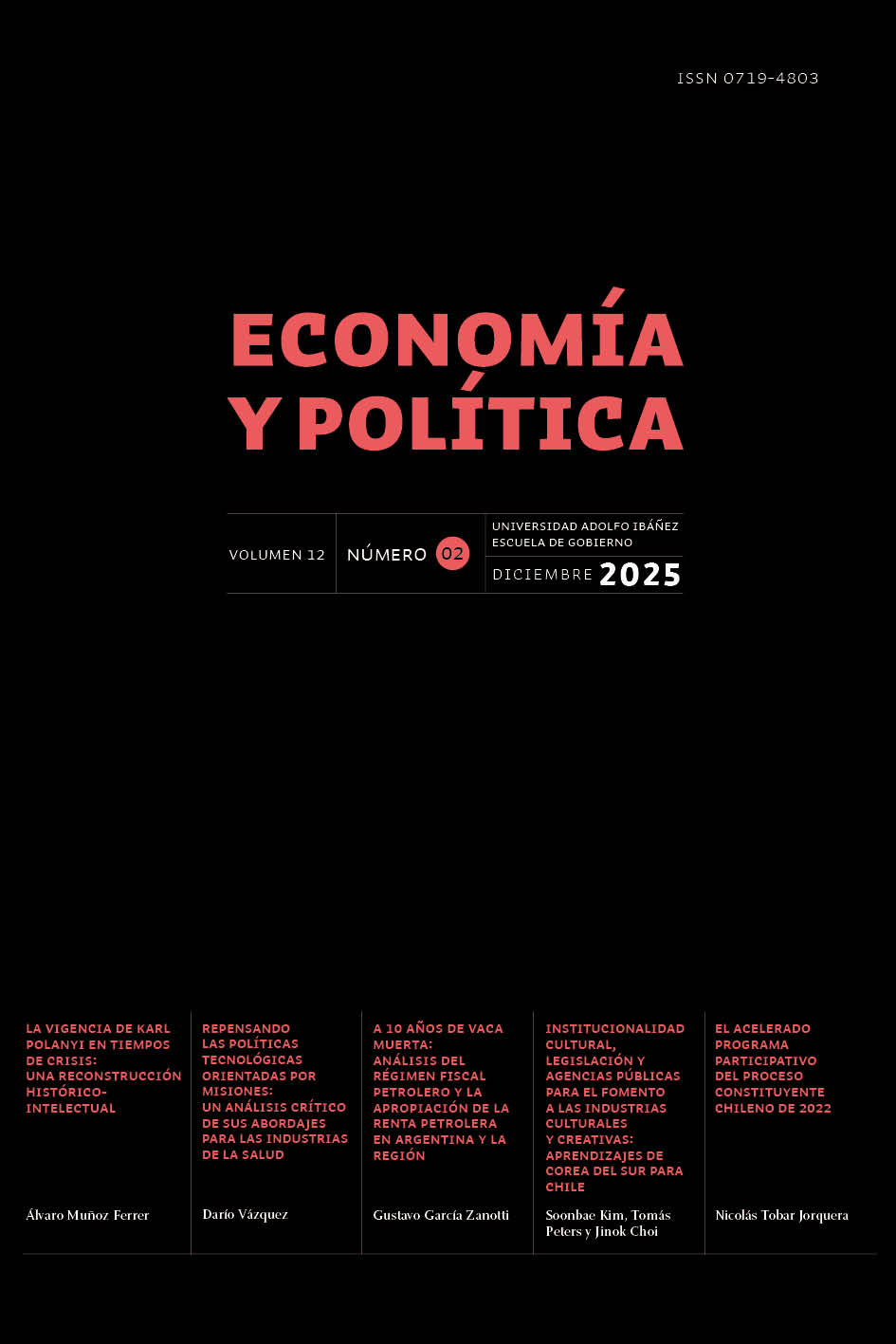
The relevance of Karl Polanyi in times of crisis: A historical-intellectual reconstruction
DOI:
https://doi.org/10.15691/07194714.2025.004Keywords:
Karl Polanyi, Economic crisis, Neoliberalism, Financialization, Embedded economyAbstract
This article examines the contemporary reception of Karl Polanyi’s thought, particularly his seminal work The Great Transformation (1944), proposing that renewed interest in his ideas tends to intensify during periods of structural crisis, when the dominant economic order is in tension and conventional explanatory frameworks become insufficient. Through a bibliographic and contextual analysis, the article identifies two major waves of reception: the first (1970–1990), articulated as a critique of emerging neoliberalism and the limitations of Keynesianism; and the second (2008–present), linked to the global financial crisis and new forms of commodification, with contributions from critical theory, solidarity economy, and economic sociology. Finally, the article offers a philosophical and epistemological reflection on the conditions that make this renewed attention possible. Overall, it argues that Polanyi’s relevance lies not merely in thematic updates, but in his ability to conceptualize the economy as a socially, institutionally, and morally embedded phenomenon in times of historical transformation.
References
Adorno, T., y Horkheimer, M. 2007. Dialéctica de la Ilustración. Madrid: Trotta [1944].
Álvarez-Uría, F. y Várela, J. 2007. “Introducción” en Polanyi, K. La gran transformación. Crítica del liberalismo económico. Buenos Aires: Quipu.
Atzmüller, R., Aulenbacher, B., Brand, U., Décieux, F., Fischer, K. y Sauer, B. 2019. Capitalism in Transformation Movements and Countermovements in the 21st Century. Cheltenham: Edward Elgar Publishing.
Block, F. 2017. Introducción. En Polanyi, K. La gran transformación. Los orígenes políticos y económicos de nuestro tiempo (Graciela Chailoux Trad.). México: Fondo de Cultura Económica.
Block, F., y Somers, M. 1984. Beyond the Economistic Fallacy: The Holistic Social Science of Karl Polanyi. En T. Skocpol (Ed.), Vision and Method in Historical Sociology. Cambridge: Cambridge University Press.
Block, F. y Somers, M. 2014. The Power of Market Fundamentalism: Karl Polanyi's Critique. Cambridge: Harvard University Press.
Caillé, A. 2007. “Présentation”. Revue du MAUSS, 29(1), 7-31.
Campillo, A. 2001. Variaciones de la vida humana. Madrid: Akal.
Cangiani, M. y Maucourant, J. 2008. Essais de Karl Polanyi. París: Éditions du Seuil.
Congdon, L. 1976. Karl Polanyi in Hungary, 1900-1919. Journal of Contemporary History (11), 167-83.
Dale, G. 2010. Karl Polanyi: The limits of the market. Cambridge: Polity Press.
Dale, G. 2016a. Karl Polanyi. A life on the left. New York: Columbia University Press.
Dale, G. 2016b. Reconstructing Karl Polanyi: Excavation and Critique. Pluto Press.
Dalton, G. 1968. Introduction. En Dalton, G. (ed) Primitive, Archaic, and Modern Economies: Essays of Karl Polanyi. New York: Anchor Books.
Dalton, G. 1971. Economic Anthropology and Development: Essays on Tribal and Peasant Economies. New York: Basic Books.
Dalton, G. 1981. Symposium: Economic Anthropology and History: The Work of Karl Polanyi. Research in Economic Anthropology (4), 1–93.
Dalton, G. y Köcke, J. 1981. The Work of the Polanyi Group: Past, Present, and Future. Artículo presentado en la Conferencia sobre Antropología Económica de la Universidad de Indiana.
Epstein, G. 2005. Financialization and the world economy. Edward Elgar Publishing.
Fernández, C., y Alegre, L. 2012. Marx y Polanyi. La posibilidad de un diálogo. Áreas. Revista Internacional de Ciencias Sociales (31), 55–64.
Fraser, N. 2013. A Triple Movement?. New Left Review, 81 (mayo-junio), 119-132.
Fraser, N. 2014. Can Society Be Commodities all the Way Down? Post-Polanyian Reflections on Capitalist Crisis. Economy and Society 43(4), 541-558.
Fraser, N. 2017. Why Two Karls are Better than One: Integrating Polanyi and Marx in a Critical Theory of the Current Crisis. En Ulf Bohmann (ed.), A Critical Theory of Politics Today. Berlín: Suhrkamp Verlag.
Fraser, N. 2020. Los talleres ocultos del capital. Un mapa para la izquierda (Traducción por Juan Mari Madariaga y Cristina Piña Aldao). Madrid: Traficantes de sueños.
Gemici, K. 2008. Karl Polanyi and the antinomies of embeddedness. Socio-Economic Review 6 (1), 5–33.
Godelier, M. 1972. Rationality and Irrationality in Economics, traducido por Pearce, B., London, NLB.
Godelier, M. 1986. The Mental and the Material, traducido por Thom, M., London, Verso.
Griffith-Jones, S., Ocampo, J. y Stiglitz, J. 2010. Time for a Visible Hand: Lessons from the 2008 World Financial Crisis, Initiative for Policy Dialogue. Oxford: Oxford Academic.
Hechter, M. 1981. Karl Polanyi's Social Theory: A Critique. Politics & Society 10(4):399-430.
Heidegger, M. 1980. “Martin Heidegger en diálogo”. En: García de la Huerta, L. M. La Técnica y el Estado Moderno. Santiago: Departamento de Estudios Humanísticos de la Universidad de Chile.
Jenkins, A. 1977. “’Substantivism’ as a Theory of Economic Forms”. En Hindess, B. (ed) Sociological Theories of the Economy, London, Macmillan, pp. 66–91.
Sahlins, M. 1981. Stone Age Economics, Hawthorne, New York, NY, Aldine Publishing Company.
Laval, C. 2007. Mort et résurrection du capitalisme libéral. Revue du MAUSS (29), 393-410.
Laval, C. y Dardot, P. 2013. La nueva razón del mundo. Ensayo sobre la sociedad neoliberal. Barcelona: Editorial Gedisa. [2009]
Le Velly, R. 2007. Le problème du désencrassement. Revue du MAUSS (29), 241-256.
Maucourant J., 2005. Avez-vous lu Polanyi ? Paris: La Dispute.
Medialdea, B., y Sanabria, A. 2014. “La financiarización de la economía mundial: hacia una caracterización”. Revista de Economía Mundial (33), 195–227
McRobbie, K., y Polanyi-Levitt, K. 2006. Karl Polanyi in Vienna: The contemporary significance of The Great Transformation. Montreal: Black Rose Books.
Maya, C. 2014. Actualidad de la crítica de Karl Polanyi a la sociedad de mercados. Política y Cultura (41), 143-166.
Munck, R. 2015. Rethinking Latin America: Back to the Future?. Latin American Perspectives 42(4), 73–91
North, D. 1977. Markets and Other Allocation Systems in History: The Challenge of Karl Polanyi". Journal of European Economic History 6(3):703-16.
Pearson, H. 1977. Editor's Introduction. En Polanyi, K., The Livelihood of Man. New York: Academic Press.
Plattner, S. 1989. “Introduction”. En Plattner, S. (ed) Economic Anthropology, Stanford, CA, Stanford University Press, pp. 1–20.
Plociniczak S. 2007. Au-delà d’une certaine lecture standard de La Grande Transformation. Revue du MAUSS (29), 207-224.
Polanyi, K. 2007. La gran transformación. Crítica del liberalismo económico (Julia Várela y Fernando Álvarez-Uría, trad.). Buenos Aires: Quipu [1944]
Polanyi, K. 2009. El sustento del hombre. (Ester Gómez Parro, trad.). Madrid: Capitán Swing Libros. [1977]
Polanyi, K. 2012. El marxismo redefinido. En Polanyi, K., Textos escogidos. Coraggio, J. (ed.). Traducción de Gabriela Ventureira y Ana Gómez. Buenos Aires: Consejo Latinoamericano de Ciencias Sociales y Universidad Nacional General Sarmiento. [1934]
Polanyi, K. 2017. La gran transformación. Los orígenes políticos y económicos de nuestro tiempo (Graciela Chailoux Trad.). México: Fondo de Cultura Económica. [2001]
Polanyi-Levitt, K. y Mendell, M. 1987a. "Karl Polanyi: A Biographical Sketch". Telos 21, 121-131
Polanyi-Levitt, K., y Mendell, M. 1987b. “Karl Polanyi: His Life and Times”. Studies in Political Economy 22(1), 7–39
Polanyi-Levitt, K. 1990. The life and work of Karl Polanyi: A celebration. Black Rose Books.
Polanyi-Levitt, K. 2006. "Keynes and Polanyi: the 1920s and the 1990s". Review of International Political Economy, 13(1), 152-177
Polanyi Levitt, K. 2013. From the Great Transformation to the Great Financialization. On Karl Polanyi and Others Essays. London: Zed Books
Polanyi-Levitt, K. 2019. "On Transformations: Past, Present and Future?". Österreich Z Soziol 44, 115–128
Polanyi-Levitt, K. y Desai, R. 2020. Karl Polanyi and twenty-first-century capitalism. London: Manchester University Press
Polo, J. 2015. También explotación, pero no sólo. Un diálogo imprescindible y polémico entre Marx y Karl Polanyi. Tópicos, Revista de Filosofía (48), 81-121
Reiss, J. 2013. Philosophy of economics: A contemporary introduction. Routledge.
Rodrik, D. 2006. Goodbye Washington Consensus, Hello Washington Confusion? A Review of the World Bank’s Economic Growth in the 1990s: Learning from a Decade of Reform. Journal of Economic Literature XLIV, 973-987.
Roy, M. y Grant, S. 2019. The Contemporary Relevance of Karl Polanyi to Critical Social Enterprise Scholarship. Journal of Social Entrepreneurship 11(2), 177-193
Saiag, H. 2009. Michele Cangiani & Jérôme Maucourant (Dir.), Essais de Karl Polanyi, introduction de M. Cangiani et J. Maucourant, postface d’Alain Caillé et Jean-Louis Laville, Paris, Seuil, 2008. Revue de la régulation [Online], 5.
Servet, J-M. 2007. Le principe de réciprocité chez Karl Polanyi. Contribution à une définition de l’économie solidaire. Revue tiers monde (189), 255-274
Stanfield, J. R. 1980. The Institutional Economics of Karl Polanyi. Journal of Economic Issues 14(3), 593-614
Stiglitz, J. 2010. Freefall: America, free markets, and the sinking of the world economy. Estados Unidos: W.W. Norton & Company
Stiglitz, J. 2017. Prólogo. En Polanyi, K. La gran transformación. Los orígenes políticos y económicos de nuestro tiempo (Graciela Chailoux Trad.). México: Fondo de Cultura Económica.
Stiglitz, J. 2017. The coming great transformation. Journal of Policy Modeling 39, 625-638
Stiglitz, J. 2019. Progressive Capitalism for an Age of Discontent. New York: Norton
Subirats, J. 2014. Acerca del renovado interés por Karl Polanyi. Cadernos EBAPE.BR 12(2), 199-205
Szecsi, M. 1979. Looking Back on The Great Transformation. Monthly Review 30(8), 34-45.
Valenzuela, I. 2016. Karl Polanyi y la teoría social en América Latina: avances, desarrollos y desafíos actuales. Polis 15(45), 249-269.
Valenzuela, J. 2013. La economía: ¿ciencia o algo parecido a la ciencia? Economía Informa (380), 5-27